UI Packs
Bitrush Cursors
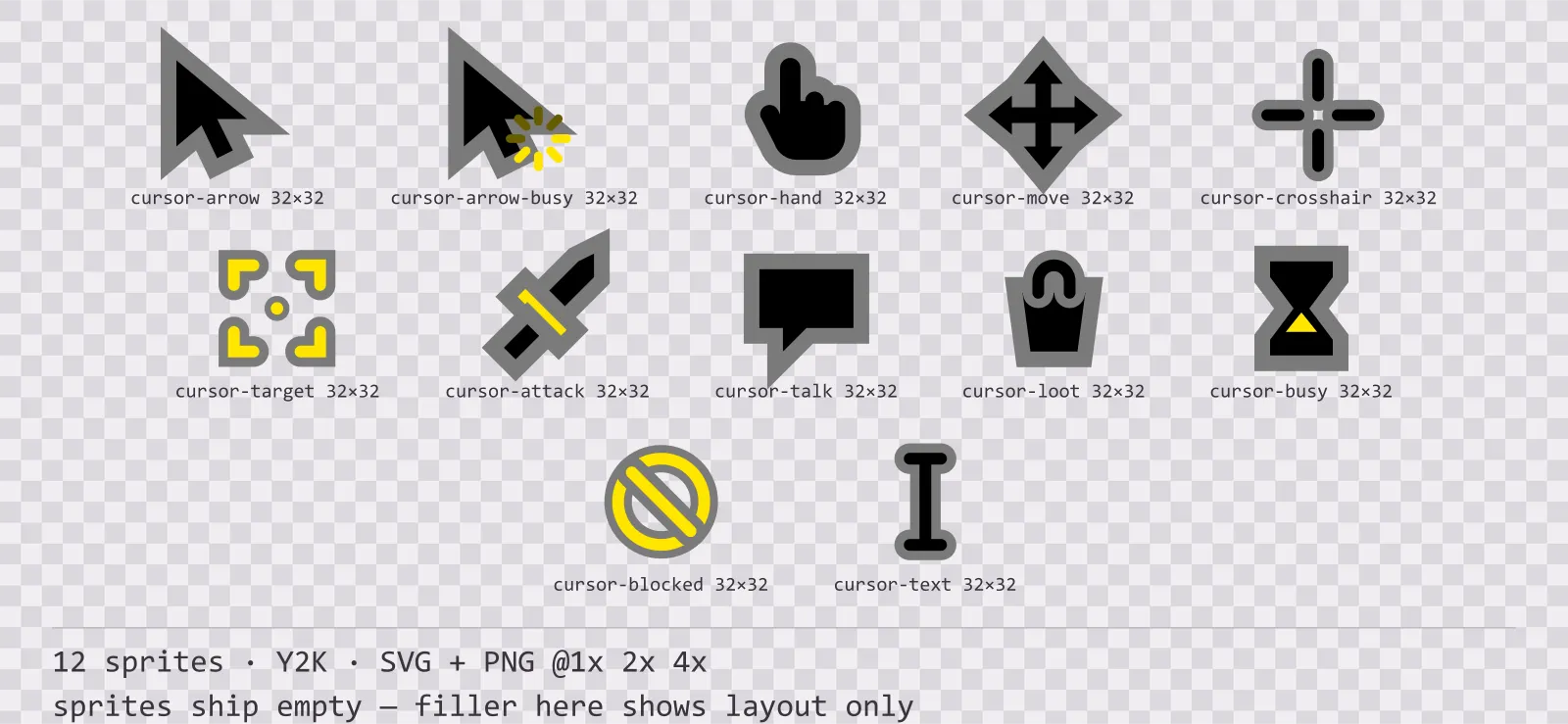
12 Y2K mouse cursors for dark interfaces — ink black with signal yellow accents. SVG plus transparent PNG at 1x, 2x and 4x.
About this pack
Bitrush Cursors is a set of 12 mouse cursors drawn in the Y2K style, where everything is flat and printed — thick straight outlines, solid blocks, no glow anywhere. It contains an arrow and an arrow with a wait ring, a pointing hand and a move cursor, a crosshair and a target lock, attack, talk and loot cursors, busy, blocked and text cursors and a resize cursor.
A game that draws its own interface and then leaves the operating system cursor on top of it has a hole in the middle of the screen, and it is the part the player looks at constantly. Cursors are also the one sprite that has no control over its background: it passes over sky, stone, fire and inventory in the same second.
No gradient and no halo: the whole set is flat colour with a heavy straight outline, which is what separates the Y2K poster look from the neon one. The silhouettes are composed corner by corner rather than scaled from one rectangle, so a badge and a banner in the same set do not share an outline.
Inside that style this is the Bitrush reading of it: a dark interface on a ink black palette with signal yellow accents, built around a header band across the top of the frame, tab-shaped buttons at 148x52, banded bars divided into 8 segments, and solid icons on a 16px grid. Those measurements are why two families can share an art style without being interchangeable: the style decides how an edge is drawn, the numbers decide what the interface is for.
Every cursor carries an outline in the opposite end of the palette from its body, which is what keeps it readable over a background the kit knows nothing about — a dark cursor over a dark cave disappears, and no amount of styling fixes that. The hotspot is named in the file title of each sprite rather than left for you to guess: the arrow clicks at 0,0 and the crosshair at its centre, and a hotspot that is off by three pixels is a game where the player misses what they aimed at.
Every sprite ships as an editable SVG and as transparent PNG at 1x, 2x and 4x, so you can drop the PNGs straight into an engine or open the vector and change a colour. Built to the same measurements as the rest of the Bitrush family, which means this kit and the Bitrush panel kit line up without either being resized. A good fit for retro-futuristic menus and poster-styled interfaces.
Download
Direct link · no sign-up · no wait pageComplete set — SVG sources, PNG exports at 1x/2x/4x, licence and readme

How to use it
- Set the hotspot from the sprite title when you register the cursor — arrow and hand click near their tip, crosshair and target at the centre of the sprite.
- Use the 32 px PNG for a hardware cursor and keep it to whole-number scaling; a hardware cursor is composited by the OS and a fractional scale is where the outline goes soft.
- Swap to the attack, talk and loot cursors from your interaction raycast rather than tinting one cursor, because the silhouette is what a player reads at a glance, not the colour.
- The blocked cursor is for a refused action, not for a disabled control — a disabled button already says that with its own sprite, and using both at once says it twice.
License
Creative Commons Zero 1.0 — Public domain. No credit required. Full terms · What this means in practice
More UI Packs
See all →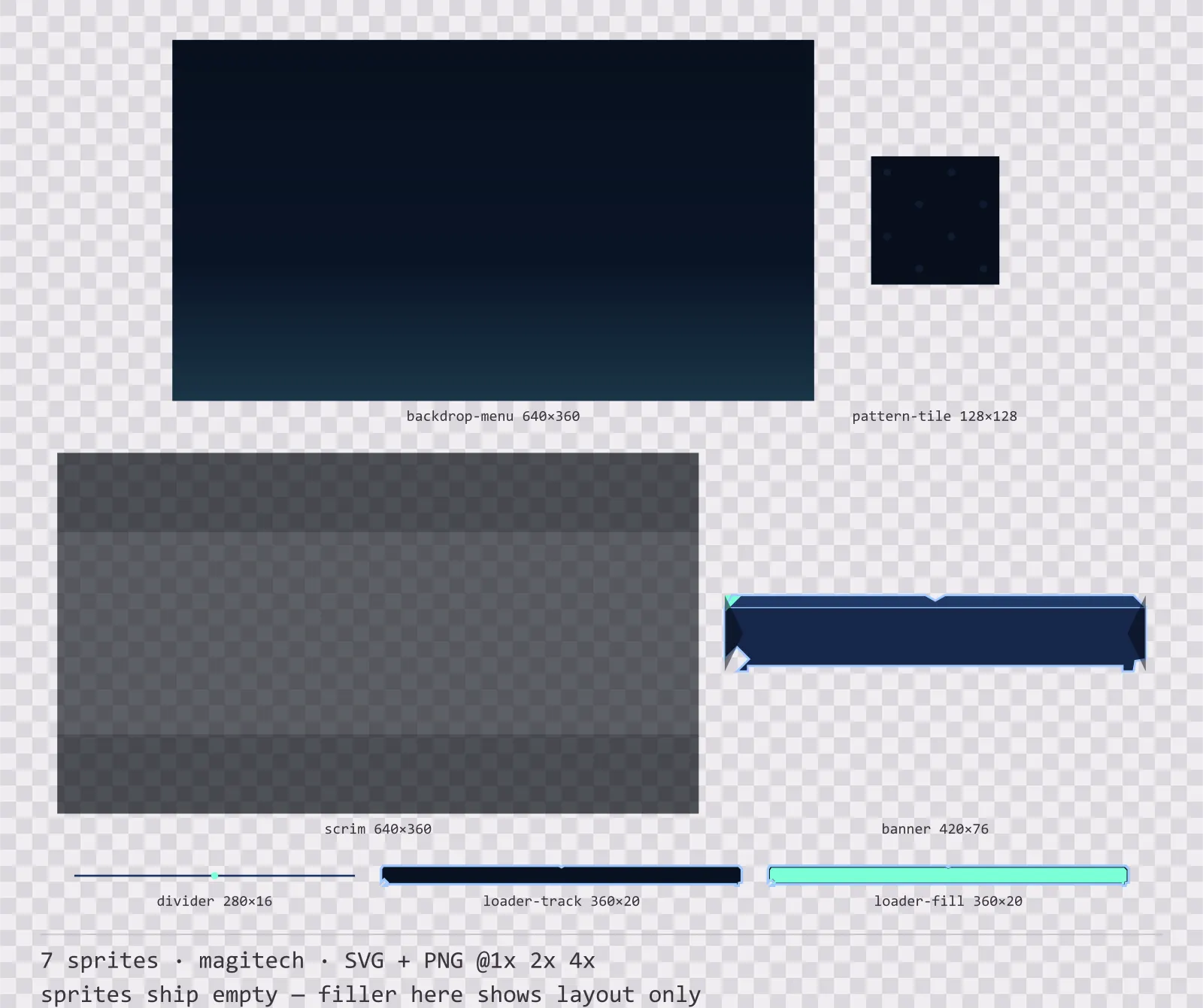
Aetherlab Backdrops
13 magitech background and overlay pieces for dark interfaces — lab navy with aether cyan accents. SVG plus transparent PNG at 1x, 2x and 4x.
Aetherlab Card Frames
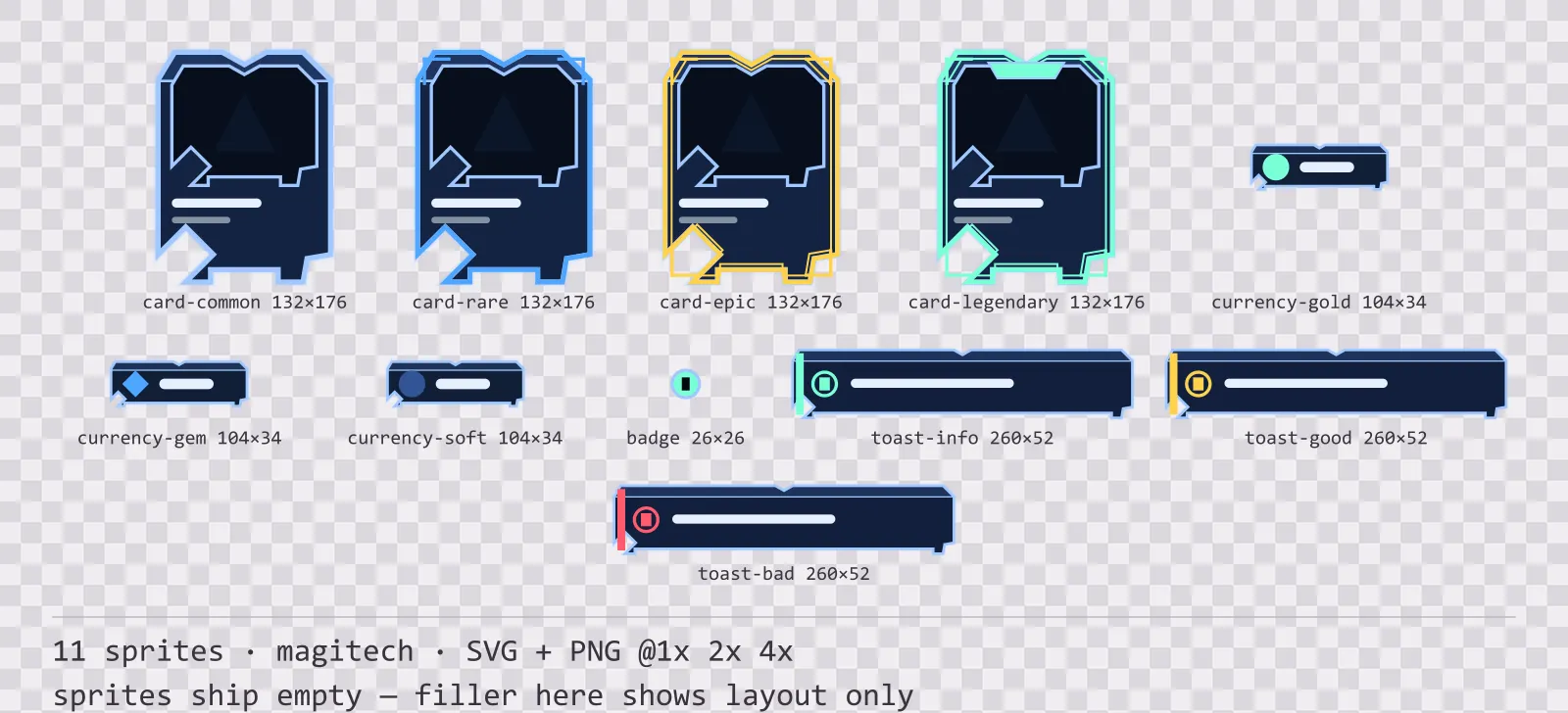
18 magitech card, currency and notification components for dark interfaces — lab navy with aether cyan accents. SVG plus transparent PNG at 1x, 2x and 4x.
Aetherlab Cursors
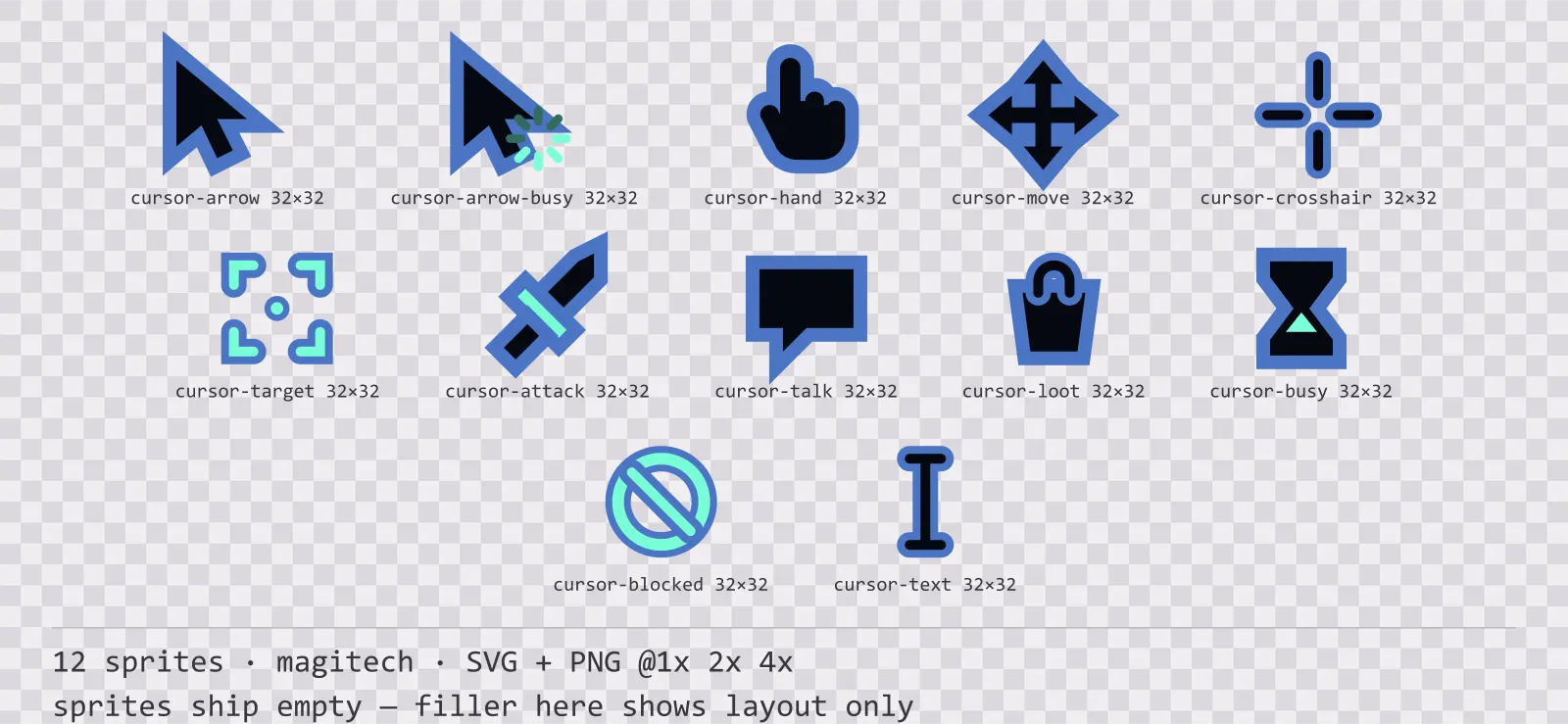
12 magitech mouse cursors for dark interfaces — lab navy with aether cyan accents. SVG plus transparent PNG at 1x, 2x and 4x.
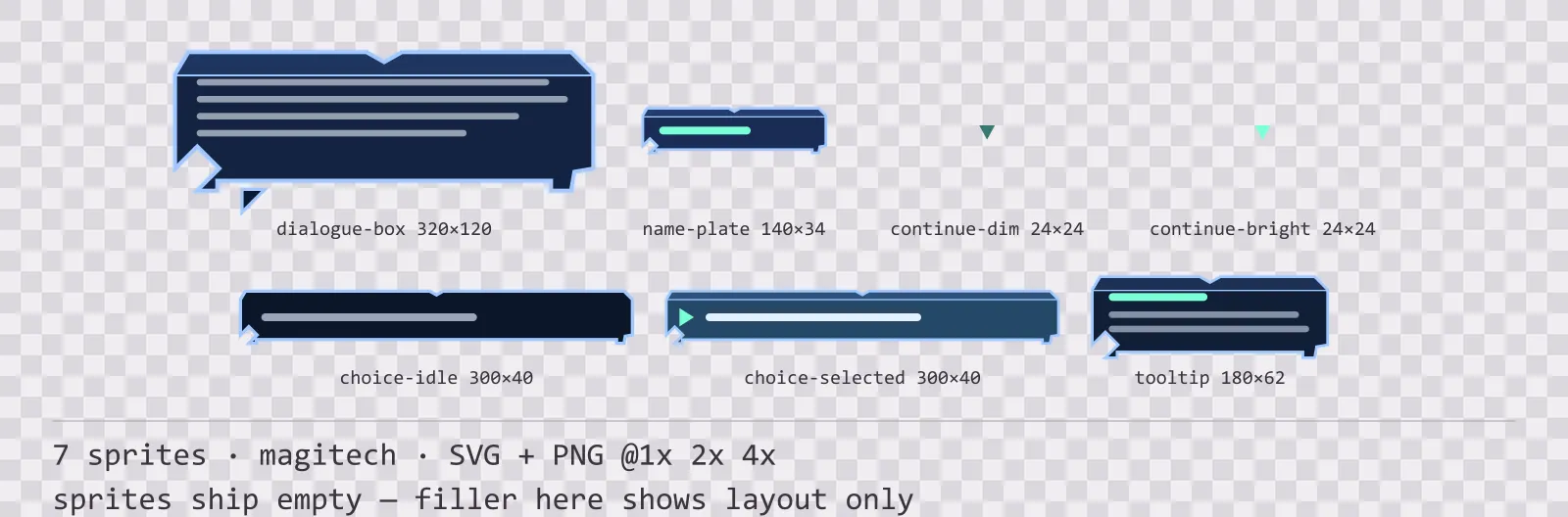
Aetherlab Dialogue Kit
15 magitech dialogue components for dark interfaces — lab navy with aether cyan accents. SVG plus transparent PNG at 1x, 2x and 4x.