UI Packs
Inkwell Map Markers
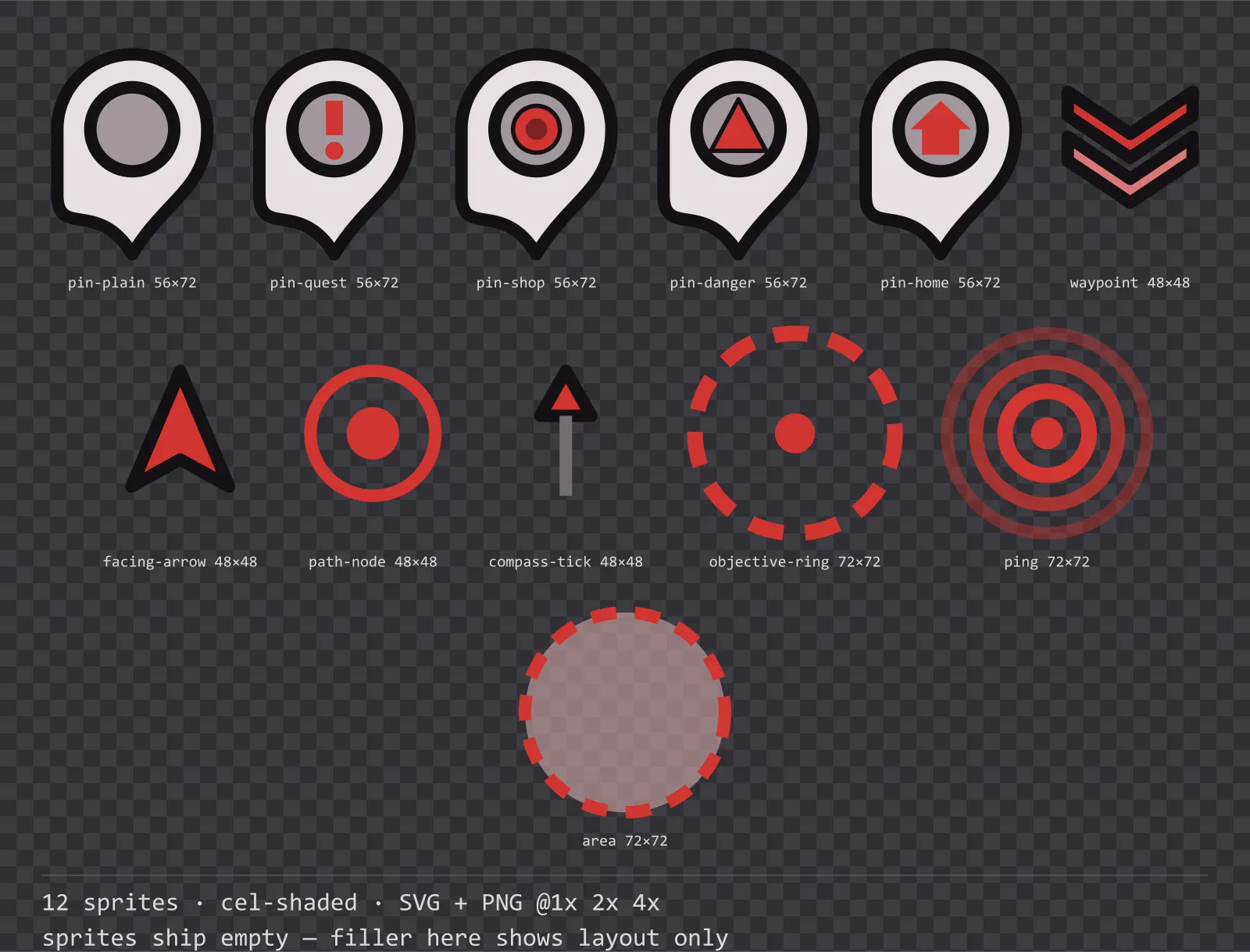
12 cel-shaded map markers and world indicators for light interfaces — flat poster with signal red accents. SVG plus transparent PNG at 1x, 2x and 4x.
About this pack
Inkwell Map Markers is a set of 12 map markers and world indicators drawn in the cel-shaded style, where a thick ink outline wraps two flat tones split by a hard diagonal terminator. It contains five map pins — plain, quest, shop, danger and home, waypoint chevrons, a player facing arrow, a route node and a compass tick, an objective ring, ping rings and an area of effect.
Interface kits cover the edges of the screen. These sit in the middle of it, on top of the game, where the kit has no idea what is underneath — grass, snow, night. A marker that relies on a background to read against will disappear over half of your levels.
The shadow is a single hard-edged shape with no falloff — the defining property of cel shading, and the thing a gradient can never imitate. The outline uses the darkest tone in the palette rather than the border tone, or it reads as a thick grey frame instead of ink.
Inside that style this is the Inkwell reading of it: a light interface on a flat poster palette with signal red accents, built around a single bordered frame, square-cornered buttons at 152x52, banded bars divided into 5 segments, and solid icons on a 24px grid. Those measurements are why two families can share an art style without being interchangeable: the style decides how an edge is drawn, the numbers decide what the interface is for.
Every marker carries its own outline and a single-colour body, so the silhouette does the work rather than the fill. The anchor is named in each sprite title and it is not the centre: a pin points at its target with the tip, so its anchor is bottom centre, while a ring and a facing arrow anchor at the middle. Placing a pin by its centre puts it half a pin above whatever it was meant to mark. The area and objective rings are dashed rather than solid because they describe a region rather than an edge — a solid ring reads as a wall.
Every sprite ships as an editable SVG and as transparent PNG at 1x, 2x and 4x, so you can drop the PNGs straight into an engine or open the vector and change a colour. Built to the same measurements as the rest of the Inkwell family, which means this kit and the Inkwell panel kit line up without either being resized. A good fit for cel-shaded and toon-rendered games.
Download
Direct link · no sign-up · no wait pageComplete set — SVG sources, PNG exports at 1x/2x/4x, licence and readme

How to use it
- Anchor each sprite by the point named in its title: bottom centre for pins, centre for rings and the facing arrow.
- Keep markers at a fixed screen size rather than scaling them with distance; a pin that shrinks with the world stops being readable at exactly the distance you needed it.
- Use the ping rings as three frames of one animation — draw them outward and fade — rather than as three separate markers.
- Tint the pin body per faction but leave the outline alone; the outline is what keeps the marker readable over an unknown background.
License
Creative Commons Attribution 4.0 — Free for commercial use. Credit required. Full terms · What this means in practice
"Inkwell Map Markers" by Oğuzhan Girgin, licensed under CC BY 4.0 — https://www.colorosse.com/assets/2d/ui/inkwell-map-markersMore UI Packs
See all →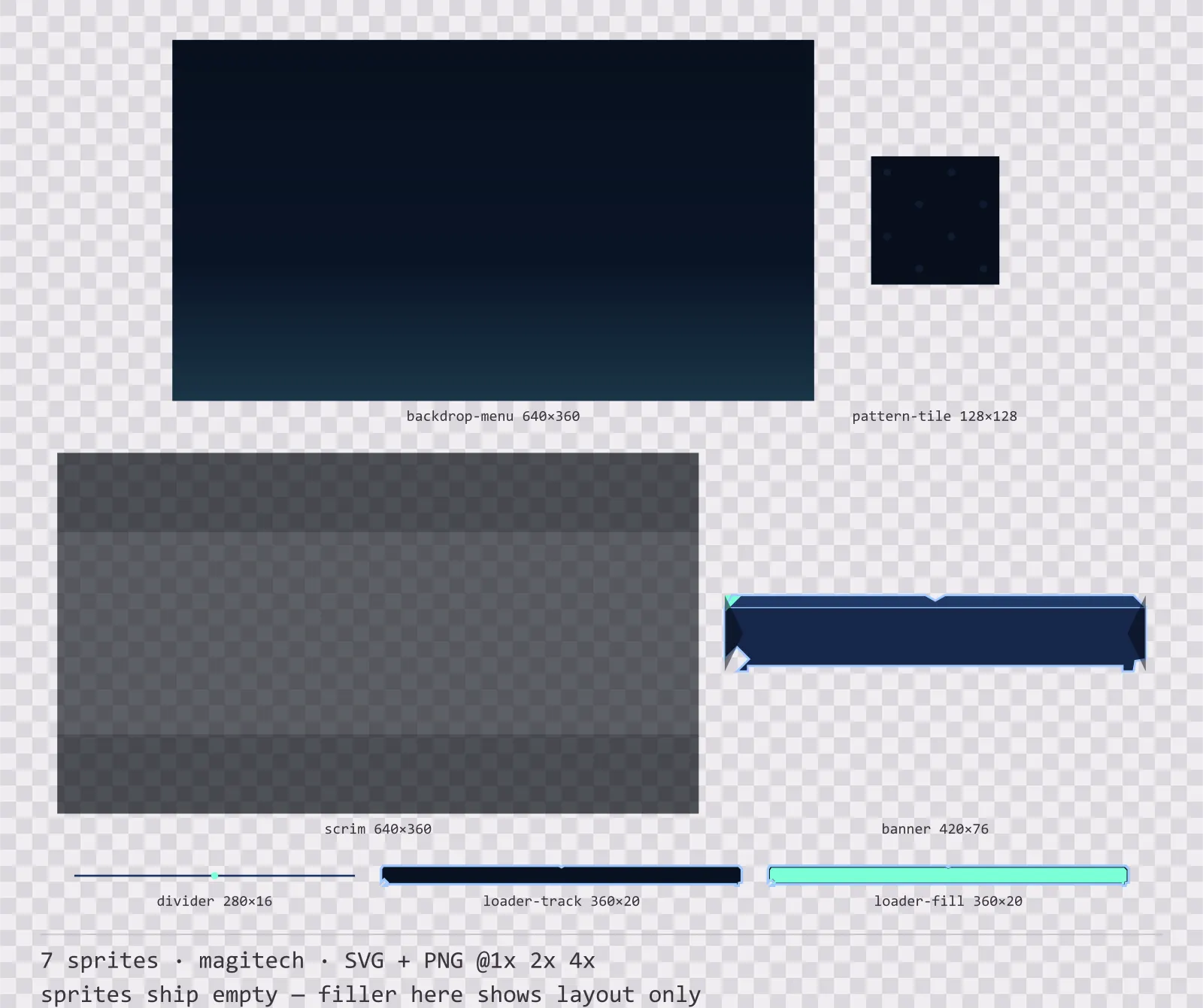
Aetherlab Backdrops
13 magitech background and overlay pieces for dark interfaces — lab navy with aether cyan accents. SVG plus transparent PNG at 1x, 2x and 4x.
Aetherlab Card Frames
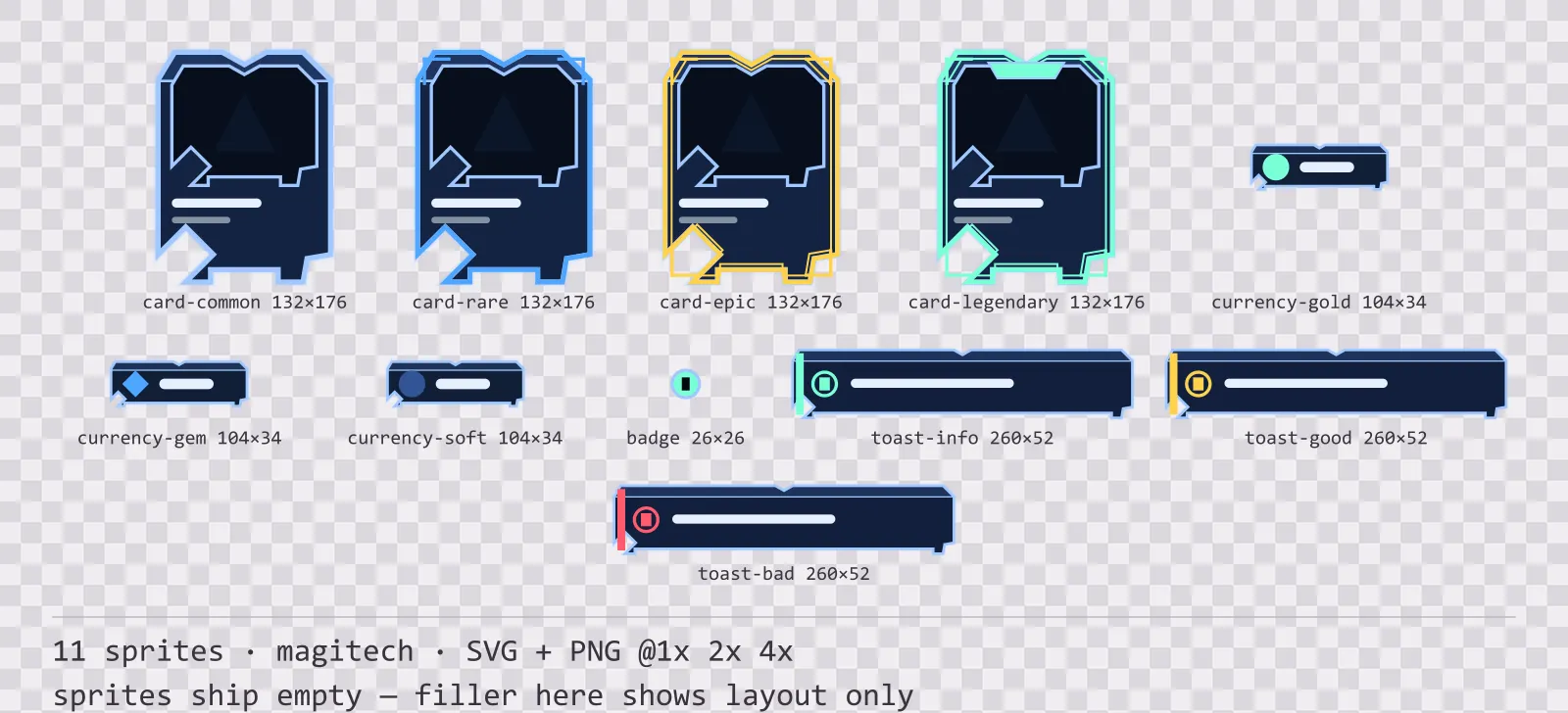
18 magitech card, currency and notification components for dark interfaces — lab navy with aether cyan accents. SVG plus transparent PNG at 1x, 2x and 4x.
Aetherlab Cursors
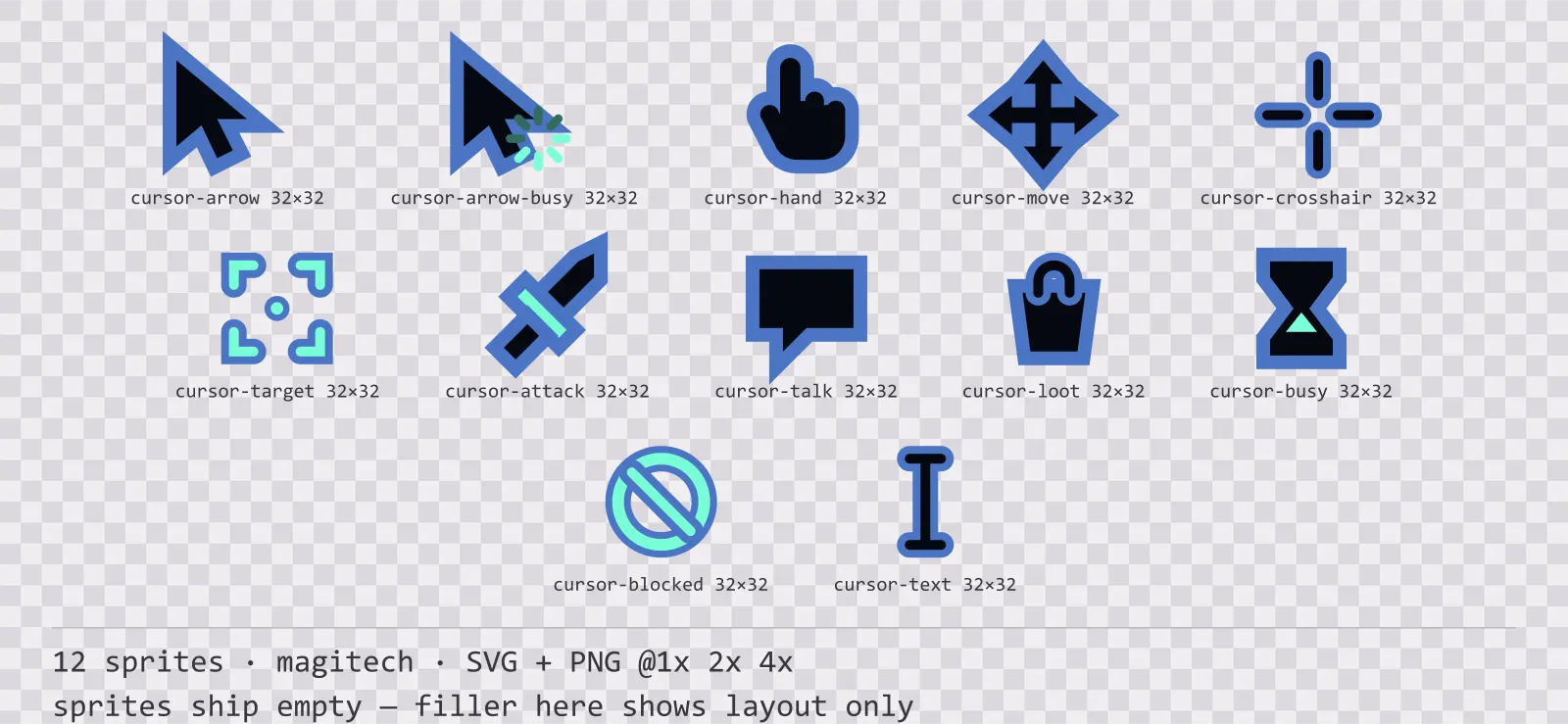
12 magitech mouse cursors for dark interfaces — lab navy with aether cyan accents. SVG plus transparent PNG at 1x, 2x and 4x.
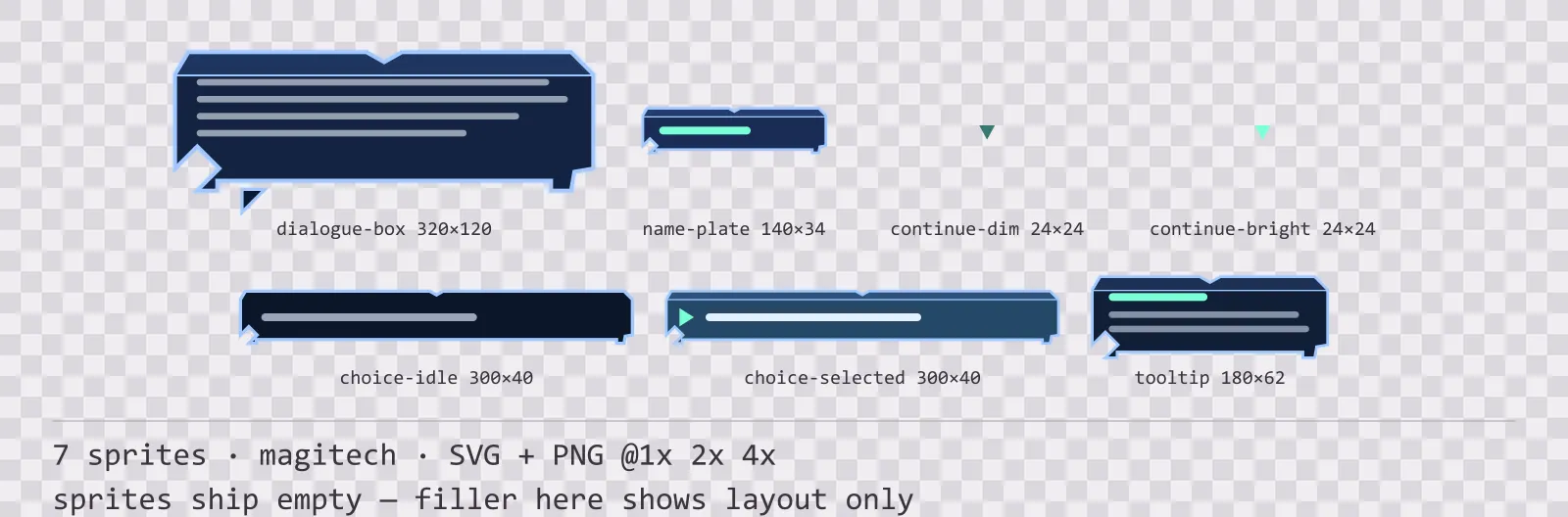
Aetherlab Dialogue Kit
15 magitech dialogue components for dark interfaces — lab navy with aether cyan accents. SVG plus transparent PNG at 1x, 2x and 4x.